Research
Scales, steps, and intervals
Small and large. Incident and trend. Individual and society. In the broadest sense, I am interested in how the singular influences the collective, and vice versa. From a young age, discovering how a bunch of little plastic bricks stuck together could produce a submarine or a castle or a seaside cabana; through my time working as an engineer to make small improvements a tiny subsystem of a huge, expensive spaceship; and into my most recent work as a researcher in fluid dynamics, studying how vortex interactions are influenced by background flow, I’ve just been fascinated by how (in so many words) a bunch of little things makes one big thing, and how what the big thing does affects the little things in turn.
My main field is fluid dynamics. I use computational methods to simulate fluid flows (i.e. computational fluid dynamics, or CFD), in order to examine their behavior in fine detail, without the need for large expensive equipment and invasive measurement probes. Of course, any simulation is only as good as its fidelity to the real world, so I also use experimental data and basic physical calculations to support my work as well.
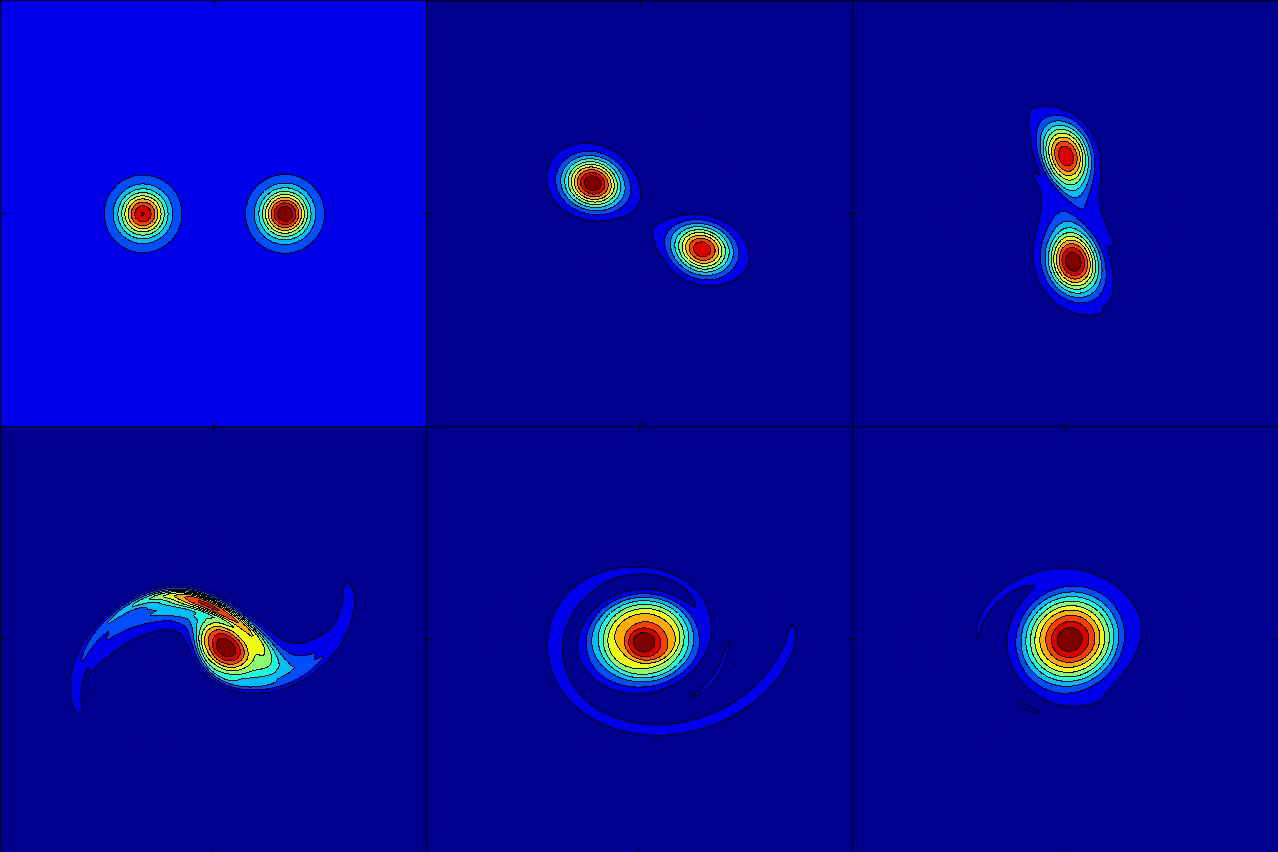
I recently finished my Ph.D. dissertation, in which I studied how two fluid vortices interact under the influence of background shear (i.e. in flow with a linear velocity gradient).
In very simple terms, when two vortices that spin the same way interact in isolation (i.e. without shear), their interaction proceeds through a consistent set of steps in which different physical processes dominate (most significantly, detrainment and entrainment). The outcome of any specific interaction depends on the relative properties (size, strength) of the two vortices at the start, which determines which processes predominate at which times. Through careful study, we determined that interaction outcomes can be consistently predicted by a single property (the vortices’ relative straining, or more conveniently, the ratio of their starting integrated enstrophies).
The presence of background shear, in broad terms, alters which processes predominate at which times. In general (though not quite universally), this tends to promote the creation of a stronger final vortex (i.e. a vortex that’s a “step up” from the starting two) at the end of interaction (by either accelerating entrainment or prolonging the interval during which it may occur, depending on the direction of the vortices’ rotation relative to the shear). Nevertheless, these outcomes can still generally be predicted accurately by the same properties (i.e. relative straining and/or integrated enstrophies ratio) as when the vortices are in isolation (i.e. when there is no shear).
Note that his is an extremely simplified explanation using simple language! Please see my papers for more detailed and precise discussion.
The interaction of two vortices that spin the same way is one mechanism by which many observed behaviors of turbulent fluid flows occur. Perhaps most significant is the flow of energy between elements of the turbulence that have different size (i.e. inter-scale energy cascades), which tends to be from larger to smaller in most flows, but which can go from smaller to larger when the flow is confined to two dimensions. I hope my recent work can help clarify how and why his occurs; such research is ongoing.
A note about computational methods
In my research, I used a modified version of an old CFD code (written in FORTRAN) because it has shear-periodic boundary conditions implemented very well. I wrote my processing scripts in MATLAB. I am planning on using OpenFOAM for upcoming work. I have also recently become proficient with finite-element analysis and methods (FEA/FEM) using Ansys software, and am excited about using it for future scientific and engineering work.
Publications:
- Patrick J. R. Folz and Keiko K. Nomura, 2023, “On asymmetric vortex pair interactions in shear,” Journal of Fluid Mechanics, 969, A21. doi: 0.1017/jfm.2023.525
- Patrick J. R. Folz and Keiko K. Nomura, 2017, “A quantitative assessment of viscous asymmetric vortex pair interactions,” Journal of Fluid Mechanics, 829, 1-30. doi: 10.1017/jfm.2017.527
- Patrick J. R. Folz and Keiko K. Nomura, 2014, “Interaction of Two Equal Co-Rotating Viscous Vortices in the Presence of Background Shear,” Fluid Dynamics Research, 46, 3, 031423. doi: 10.1088/0169-5983/46/3/031423
Presentations:
- Interaction regimes of unequal viscous vortex pairs in the presence of background shear, 67th Annual Meeting of the American Physical Society Division of Fluid Dynamics, San Francisco, USA, 2014: deck (.pptx) (Note: some of this info is out of date, presentation available for archival and demonstration purposes only!)
Posters:
- IUTAM Symposium on Vortex dynamics: formation, structure and
function, Fukuoka, Japan, 2013: poster (.pdf) (Note: some of this info is out of date, poster available for archival and demonstration purposes only!)
 patrickfolz
You must be logged in to post a comment.